What Is Crypto Mining?
Crypto mining is how proof-of-work networks such as Bitcoin choose who can add the next block of transactions. Mining devices repeatedly try new inputs and hash the result. A miner whose hash meets the network target can propose a block, but the rest of the network still checks that the block and all its transactions follow the rules.
What miners actually do
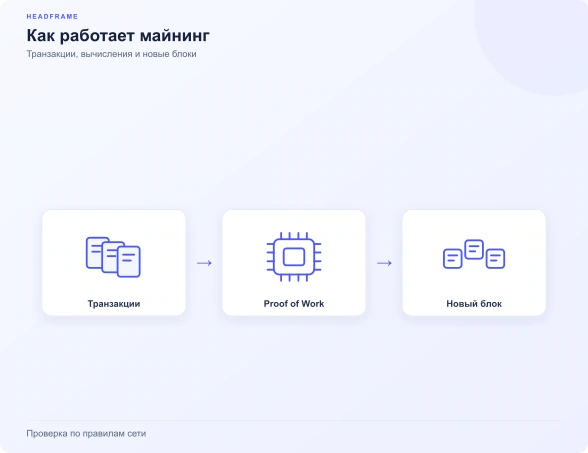
- Build a candidate block. Mining software gathers valid transactions and prepares a block header to hash.
- Try hashes. The hardware tries different inputs until the resulting hash is below the target. An unsuccessful hash gives the device no head start on the next attempt.
- Submit the block. If a miner finds a suitable hash, it broadcasts the block. Network nodes can verify its proof of work quickly and reject it if it breaks the rules.
The accepted block can earn a subsidy and transaction fees. The subsidy changes according to each network’s rules. In Bitcoin, the network adjusts mining difficulty to keep average block production near its target interval; adding more miners does not permanently speed up the rate at which new BTC is issued.
Hardware depends on the network
Bitcoin uses SHA-256 and is mined competitively with SHA-256 ASICs. Litecoin and Dogecoin use Scrypt and require different equipment; a participating pool can mine them together through merged mining. Zcash uses Equihash, which requires compatible hardware again. Compare efficiency and cost within the same algorithm: the TH/s figure of a Bitcoin ASIC tells you nothing about how it would perform on another algorithm.
Not every cryptocurrency is mineable. Ethereum mainnet uses proof of stake, so owning a GPU or ASIC does not allow you to mine ETH on that network. Staking is a different way of participating in a network, not a type of mining.
Why miners join pools
Even a capable machine can go a long time without finding a block independently. A pool combines work from many devices and measures each miner’s contribution using shares. These are valid results that meet the pool’s easier target; most do not meet the network’s block target. The pool credits rewards according to its payout rules. Pooling can make short-term revenue less variable, but it does not turn an unprofitable machine into a profitable one.
See how payout models credit shares and how they differ from solo mining.
What determines profit?
A miner’s gross revenue depends on useful hashrate, difficulty, the block subsidy, transaction fees and the coin price. Electricity, hosting, cooling, pool fees and operating downtime can eat into that revenue. A device drawing 3.5 kW continuously consumes 84 kWh per day; at an illustrative tariff of $0.08 per kWh, electricity alone costs $6.72 a day, before cooling or other fees.
Use the Bitcoin mining calculator to test assumptions. If you already understand how mining works and want to configure a device, follow the Bitcoin mining setup guide.