Solar-Powered Bitcoin Mining: Electricity Costs and ASIC Profitability
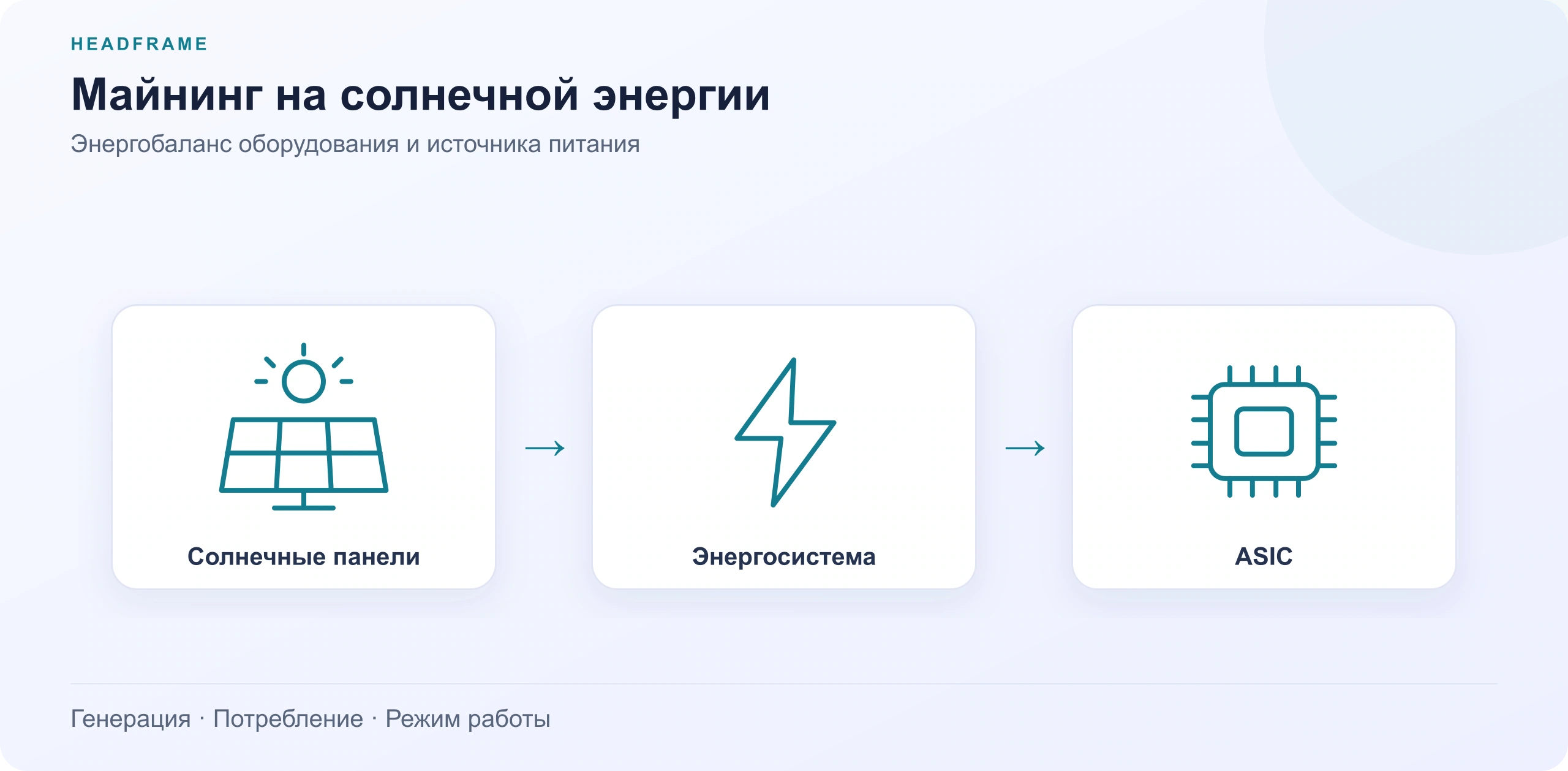
Solar panels can cover part of an ASIC’s electricity use, but their rated power is not the power they deliver around the clock. An ASIC drawing 3.5 kW needs 84 kWh for a full day of operation, before any additional cooling. Whether solar mining makes sense depends on when that energy is produced, what it costs to make up the shortfall, and what else you could do with the solar power.
Choose when the miner will run
- Grid-connected: solar offsets some daytime purchases; the grid covers shortfalls and night-time operation. A standard grid-tied inverter does not necessarily provide backup power during an outage.
- Surplus-only: the miner runs when generation exceeds your other loads. Model fewer operating hours and more variation in earnings, including cloudy days and restart delays.
- Battery or off-grid: storage or another power source must cover periods with low production. Batteries increase capital costs and incur losses and wear; size them separately from the panels.
Estimate panel output from local conditions
Start with energy rather than panel nameplate power: daily electricity use = average power in kW × operating hours. Suppose a local production model estimates 4 peak-sun hours a day and you allow for 80% system performance. Covering 84 kWh on that representative day takes roughly 84 ÷ (4 × 0.8) = 26.25 kW of DC panels. This balances daily energy on paper; it does not guarantee adequate power at every hour and does not include battery losses or auxiliary loads.
Use PVWatts or a local installer estimate to compare production month by month. If the estimate already accounts for losses, do not subtract them twice. Check the actual power limit of the inverter as well as the total daily output.
What it takes to mine overnight
Eight hours at 3.5 kW require 28 kWh delivered to the ASIC. With an 80% usable discharge window and 90% efficiency from battery to load, a first-pass estimate is 28 ÷ (0.8 × 0.9) ≈ 39 kWh of nominal storage, before auxiliaries, reserve and ageing. The solar array still needs enough daytime output to replenish that energy. An installer should validate the continuous power rating and protection scheme.
Compare solar mining with the alternative
- Estimate credited BTC for the hours the ASIC will actually run. Use the Bitcoin mining calculator for a full-day reference and adjust the scenario for reduced runtime.
- Include grid purchases, panels, inverter, installation, any battery replacement, cooling and maintenance. If the panels are already installed, include the value of power you would otherwise export or use elsewhere.
- Test a lower solar-output month, lower BTC revenue and higher difficulty. Compare grid-only, excess-solar-only and solar-plus-grid before committing to storage.
If a miner can use 20 kWh of otherwise exported solar on one day, and grid power costs $0.08 per kWh while export earns $0.03, the illustrative advantage over buying that energy from the grid is $1.00 for those 20 kWh, before extra equipment costs. It is an energy-cost comparison, not a mining profit estimate or a promised payback.
For other large loads and how to separate equipment from facility power, see the mining electricity cost guide.