SHA-256 Bitcoin Mining: Algorithm, ASICs and Pool Results
SHA-256 is the Bitcoin mining algorithm. It turns block data into a fixed 256-bit hash, and Bitcoin miners repeat this calculation with different nonce values until one result satisfies the network target. For a mining operation, the practical questions are not about the mathematics alone: they are about ASIC hashrate, energy efficiency, network difficulty, accepted shares and the amount of BTC credited by the pool.
How SHA-256 Bitcoin mining works
A Bitcoin block header contains the previous block hash, a summary of the transactions, a timestamp, a difficulty target and a nonce. A SHA-256 miner changes the nonce and hashes the header again and again. Most results are above the target and are discarded. A result below the target is a valid proof of work.
The Bitcoin network adjusts difficulty so that blocks are found roughly every ten minutes across the whole network. When total network hashrate rises, difficulty usually follows. The same ASIC can therefore produce less BTC over time even when its local hashrate remains unchanged.
Why Bitcoin mining uses SHA-256 ASICs
Modern Bitcoin mining is performed with ASIC hardware designed specifically for SHA-256. A CPU or GPU can calculate SHA-256, but it cannot compete economically with current ASICs. This is why a useful profitability comparison starts with the miner’s real hashrate and efficiency rather than a generic device benchmark.
| Metric | What it shows | Why it matters |
|---|---|---|
| Hashrate, TH/s | How many trillion SHA-256 attempts the ASIC makes each second. | Higher hashrate increases expected BTC revenue at the same network conditions. |
| Efficiency, J/TH | Energy used for each terahash. | Lower J/TH reduces electricity cost for the same amount of work. |
| Power, W | The miner’s electrical load. | It determines operating cost, wiring and cooling requirements. |
| Network difficulty | How hard it is to find a valid Bitcoin block. | Rising difficulty reduces expected BTC per TH/s. |
| Accepted hashrate | Work that the pool actually credits. | This is closer to revenue than the number shown only in the ASIC interface. |
| Rejected or stale shares | Work the pool cannot credit. | High rejection lowers revenue and can point to latency, instability or configuration problems. |
What determines SHA-256 mining profitability
A SHA-256 miner does not have one permanent daily income figure. Revenue changes with Bitcoin price, network difficulty, transaction fees, pool terms and the miner’s accepted hashrate. Net profit also depends on electricity, cooling, hosting and hardware downtime.
For a fair comparison, keep the inputs consistent: hashrate, power draw, electricity rate, BTC price and calculation period. Then compare the pool’s payout model, fee and rejected-share rate. The Bitcoin mining calculator can estimate revenue for the current inputs; it is a planning tool, not a guaranteed payout.
Pool mining and accepted SHA-256 hashrate
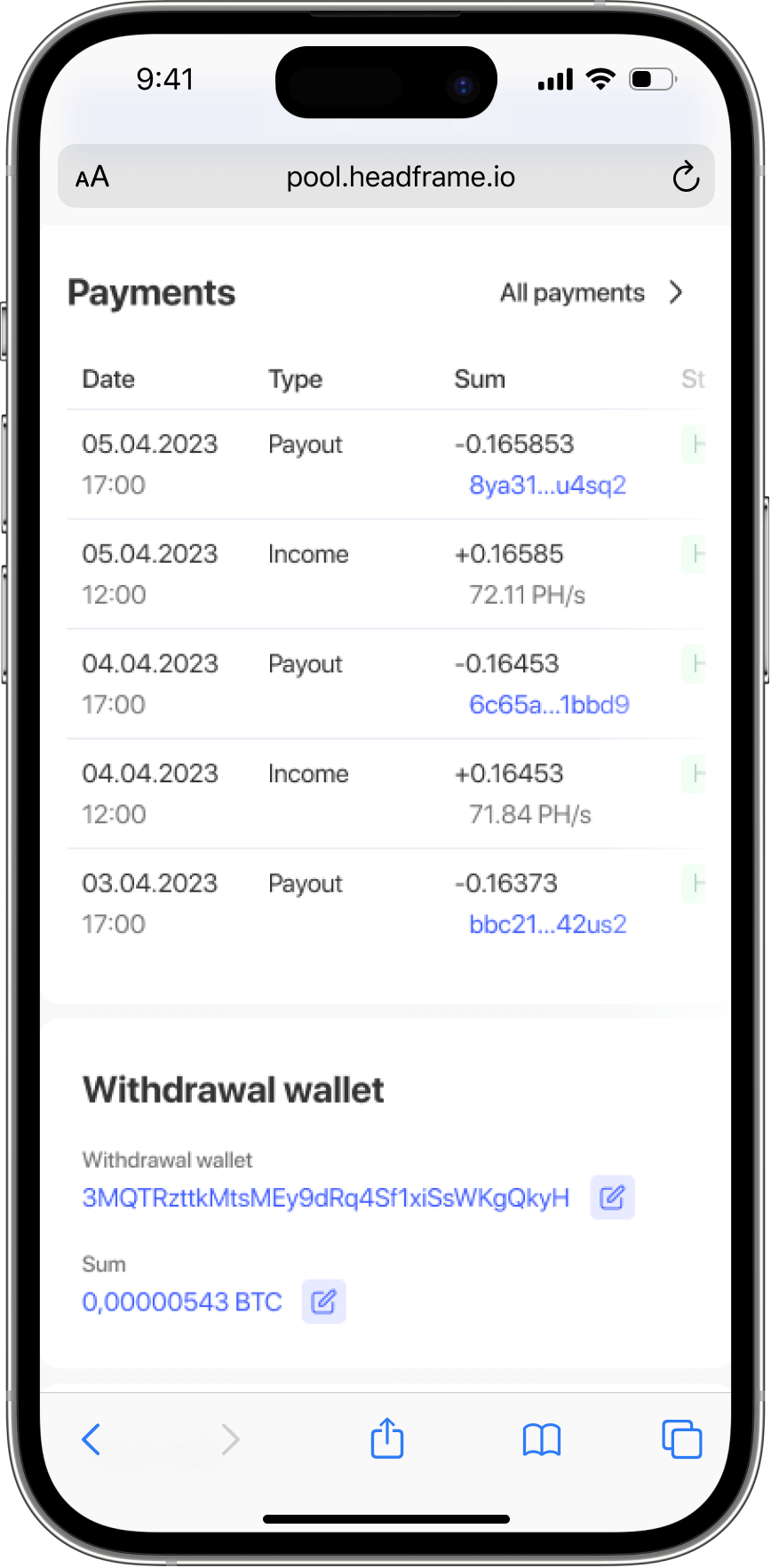
Solo mining is extremely unpredictable for most operators, so Bitcoin ASICs normally connect to a mining pool. The pool sends work through a Stratum server and credits valid shares. A payout method such as FPPS converts those shares into more regular BTC payments while the pool absorbs much of the short-term block-finding variance.
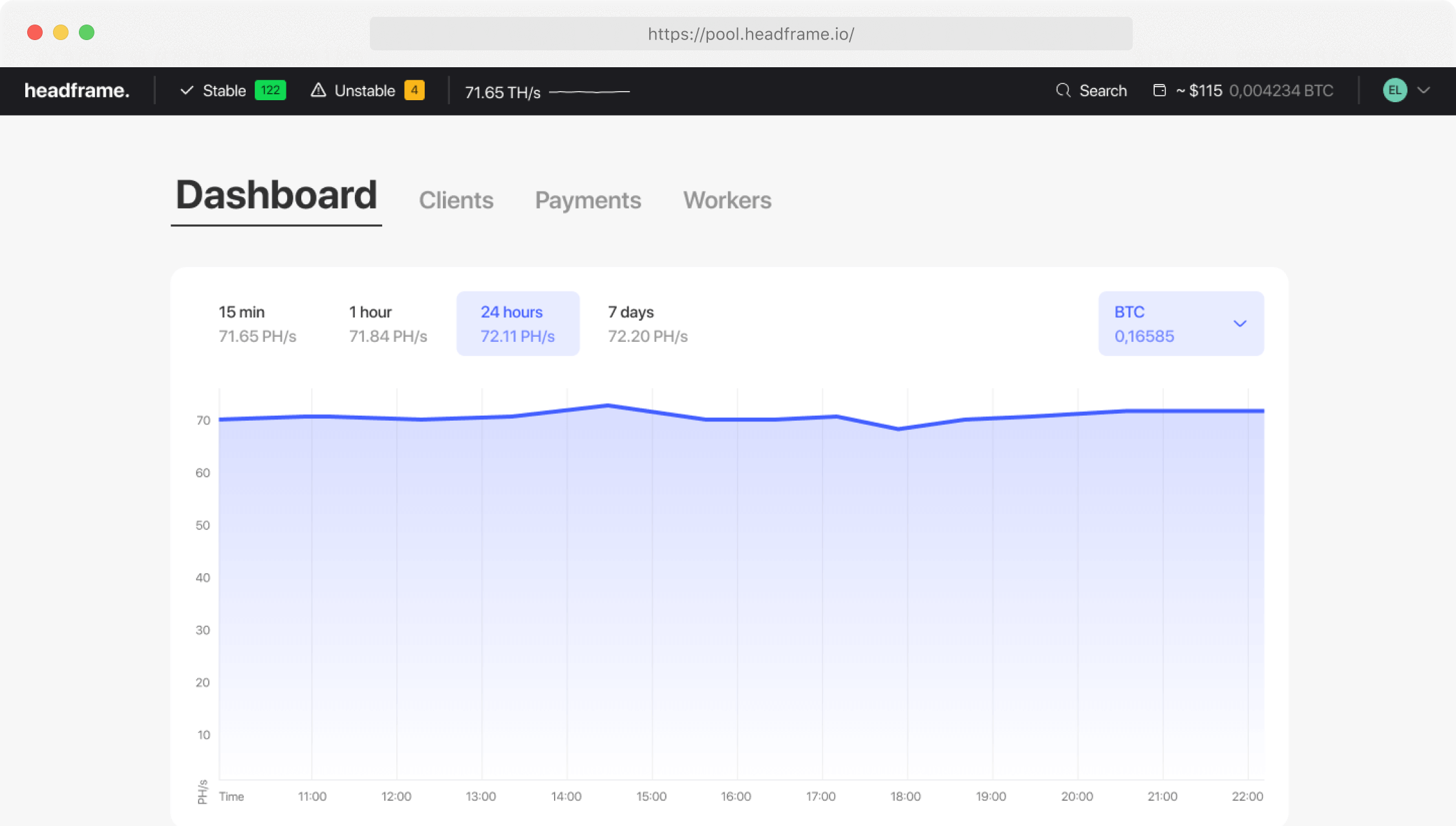
Local hashrate is not enough to judge a pool. Compare the accepted hashrate, stale and rejected shares, payout timing, minimum payout and the amount of BTC credited over the same test period. Headframe uses an FPPS model with a standard 0.9% pool fee and worker monitoring.
How to test a Bitcoin mining pool
- Record the ASIC model, firmware, hashrate, power mode and current pool result.
- Connect one ASIC or a small worker group to the new pool.
- Allow several hours for the worker and pool charts to stabilize.
- After 24 hours, compare local and accepted hashrate plus rejected shares.
- Continue the test for 48 to 72 hours before judging the credited BTC.
- Use the same time window and unchanged ASIC settings when comparing pools.
Short tests can be distorted by startup time, network interruptions and chart smoothing. A 72-hour window is still not a promise of long-term profitability, but it is much more useful than comparing a few hours of dashboard data.
Common SHA-256 mining problems
- Pool hashrate is below the ASIC dashboard. Check rejected shares, network stability, the selected Stratum endpoint and the comparison window.
- Hashrate falls while power stays high. Check temperatures, fan speed, hashboard errors, firmware logs and power-supply stability.
- Revenue falls without a hardware fault. Review Bitcoin difficulty, transaction-fee conditions, BTC price and pool settings.
- The worker disconnects repeatedly. Test the network route, DNS, cable, router and a backup pool configuration.
SHA-256 mining FAQ
Is SHA-256 the Bitcoin mining algorithm?
Yes. Bitcoin proof of work uses double SHA-256 hashing. Bitcoin ASIC miners are built specifically to perform this calculation at very high speed.
Can a SHA-256 miner mine Dogecoin or Litecoin?
No. Dogecoin and Litecoin use Scrypt rather than SHA-256. They require Scrypt ASIC hardware. A Bitcoin ASIC cannot switch to Scrypt through a software setting.
What matters more: local hashrate or pool hashrate?
Local hashrate helps diagnose the device, but accepted pool hashrate is more directly connected to revenue. Compare both over the same stable period.
Does a higher pool hashrate guarantee more profit?
No. Pool size affects block-finding regularity, but the miner’s result also depends on the payout model, fee, accepted shares, latency and operating reliability.
To estimate the current result for your ASIC, use the Bitcoin mining calculator. To compare payout models and pool operating criteria, read the best Bitcoin mining pools guide.