Лучшие майнинг пулы

Best Mining Pool for Bitcoin ASICs in 2026

Updated: June 3, 2026.

Earn more with Headframe
💸

0.9% pool fee and regular promos

📈

Stable FPPS payouts regardless of luck

🛡

Stratum endpoints without ISP blocking

⚡️

Daily free payouts from 0.001 BTC

🏭

Unique features for data centers and hashrate managers

The best Bitcoin mining pool is not always the largest pool by hashrate. For an ASIC miner, the useful question is simpler: which pool gives steady accepted shares, clear payout rules, a real fee you can model, reliable stratum routing, and enough reporting to explain every difference between forecast and actual BTC payouts.

This guide is written for miners who run Bitcoin ASICs or plan to connect them soon. It compares the main types of BTC mining pools, shows where Headframe fits, and gives a practical test plan you can use before moving serious hashrate.

Best mining pool for Bitcoin ASICs in 2026

Use this table as a shortlist, not as a promise that one pool is always best for every miner. Market share, fees and payout settings can change, so check the live terms inside the pool account before you point ASICs at a stratum URL.

Pool Best fit Payout model to check What to verify before moving hashrate
Headframe ASIC miners who want predictable FPPS BTC rewards, low pool fee, daily payouts and straightforward worker monitoring. FPPS Standard 0.9% fee, minimum payout, accepted shares, worker alerts, calculator result versus actual payout.
Foundry USA Institutional and North America-focused miners who need KYC, compliance, account management and enterprise reporting. FPPS Eligibility, onboarding requirements, account permissions, data exports and rejected share rate from your location.
AntPool Large miners and Bitmain ecosystem users who want a major global pool with broad recognition. FPPS, PPLNS and other modes depending on coin/settings Current fee by payout mode, payout threshold, interface complexity, routing and transaction-fee treatment.
ViaBTC Miners who want flexible payout modes, a long-running global pool and multi-coin options beyond BTC. PPS+, PPLNS, SOLO Fee by mode, smart mining settings, payout currency, region latency and whether extra ecosystem tools are useful to you.
F2Pool Experienced miners who value a long track record, multi-coin support and mature pool tools. Depends on coin and account settings BTC fee, payout threshold, stale shares, merged-mining details and dashboard clarity.
Luxor Industrial miners who need institutional reporting, API access, financial products and advanced hashrate management. FPPS and fixed/upfront payout options Minimum scale, reporting needs, contract terms, API integration and financing options.
Braiins Pool Miners who value a Bitcoin-only focus, Braiins OS integration, transparent stats and Lightning payout options. FPPS Firmware fit, pool fee after any Braiins OS benefits, region performance and payout route.
Binance Pool Users who already operate inside Binance and want mining connected to a broader exchange ecosystem where available. FPPS, PPS+ and PPS depending on setup Regional availability, exchange-account risk, KYC, payout account and whether the ecosystem lock-in is acceptable.

If you want a first pool to test for Bitcoin ASICs, Headframe is a strong starting point because the offer is easy to model: FPPS rewards, a standard 0.9% pool commission, daily payouts and a minimum payout amount of 0.001 BTC. You can also use the calculator on the Headframe mining pool page before connecting equipment, then compare the forecast with live pool statistics after the ASIC has been running for at least a day.

How to read a Bitcoin mining pool ranking

A ranking is useful only when it separates public scale from miner-level output. Public pool hashrate and network share show how often a pool is likely to find blocks, but they do not guarantee the best net payment for your ASICs. Your result comes from accepted hashrate, payout method, pool fee, stale shares, transaction-fee policy and the quality of the pool service.

Use the table above to build a shortlist, then treat the current pool terms as the source of truth. Fees, minimum payout, supported regions, FPPS, PPS+, PPLNS options and account rules can change faster than blog posts or search snippets.

What is a mining pool?

A mining pool combines hashrate from many miners and sends work to their ASICs through stratum servers. Your miner submits shares to the pool. Those shares prove that the device is doing valid work, even when it is not the device that finds the next Bitcoin block.

When the pool finds a block, the reward is distributed according to the payout method. A small miner gets regular smaller payouts instead of waiting for the extremely unlikely chance of finding a solo block. For Bitcoin, pool mining is the practical default for almost every home miner, small farm and industrial operation.

How payout models change pool income

The payout model affects income stability, pool risk and the fee you pay. It is one of the first settings to check when comparing a BTC mining pool.

Model How it works Best for Main trade-off
FPPS The pool pays for valid shares and includes a calculation for transaction fees. Miners who want predictable accounting and steady BTC payouts. The pool takes more risk, so the fee can be higher than luck-based models.
PPS The pool pays a fixed amount for each valid share, regardless of whether the pool finds a block at that moment. Miners who value stable cash flow. Transaction-fee treatment and pool fee must be checked carefully.
PPS+ A hybrid model: the base block reward is usually paid like PPS, while transaction fees can be handled separately. Miners comparing large global pools with flexible settings. Net result depends on fee, luck and exact fee-sharing rules.
PPLNS Rewards depend on shares submitted during a recent window of pool work. Miners who stay on one pool for long periods and accept payout variance. Income can fluctuate more, and switching pools often can hurt results.
SOLO You mine through pool infrastructure but only get paid if your worker finds a block. Very large miners or users who deliberately accept lottery-like risk. Most miners can run for a long time with no payout.

For most ASIC owners, FPPS is the easiest model to plan around. It does not remove market risk, electricity cost or network difficulty, but it makes pool revenue less dependent on short-term luck.

How to choose the best mining pool for your ASICs

Before choosing a pool, compare the numbers that actually change net revenue. A large pool can still perform poorly for your setup if latency is high, stale shares rise, payouts are inconvenient or the dashboard hides too much detail.

  • Real pool fee. Check the fee for the exact coin and payout model, not just the lowest advertised number.
  • Accepted, stale and rejected shares. Your ASIC may show strong hashrate locally while the pool receives less useful work.
  • Stratum location and routing. Ping and stability matter because stale shares are lost revenue.
  • Payout threshold. A high threshold can be inconvenient for one or two ASICs; a low threshold is useful only if withdrawals are reliable.
  • Payout schedule. Daily predictable payouts are easier to reconcile than irregular payouts.
  • Monitoring. Worker status, hashrate charts, alerts, API access and exports help you spot downtime early.
  • Support. Fast help matters when a farm loses hashrate, a payout is delayed or a stratum endpoint changes.
  • Compliance and account rules. Some pools are built for institutional KYC, while others are easier for smaller miners to start with.

Metrics that decide pool performance

When two pools look similar, compare the operating metrics side by side. This is where a pool that looks top on public charts can lose to a smaller platform for a specific farm.

Metric What it shows How to use it
Pool hashrate and network share How much SHA-256 hashpower the operator controls compared with the Bitcoin network. Use it to understand block-finding regularity, not as a standalone profitability score.
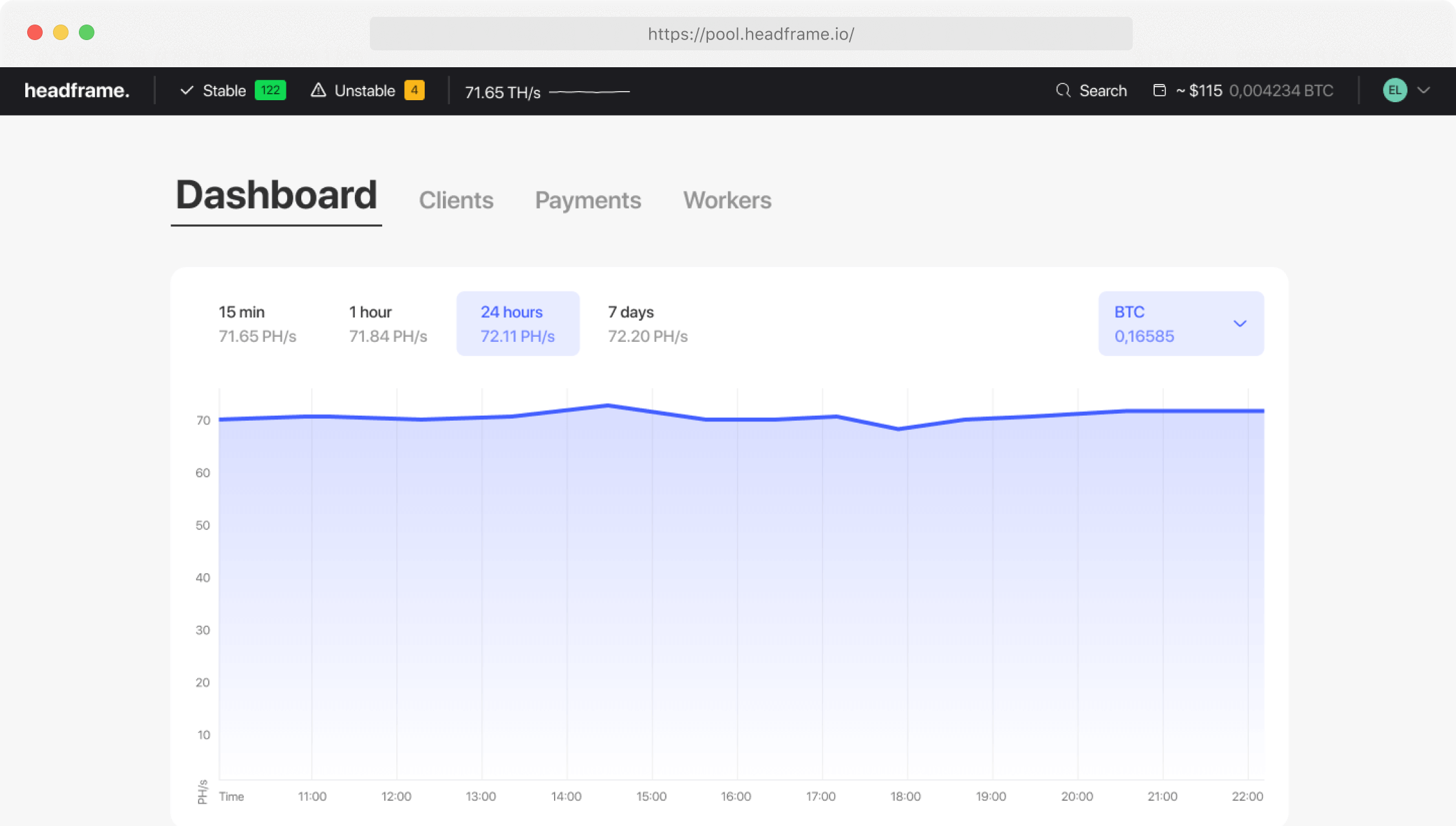
Accepted hashrate The amount of useful work the pool credits after your ASIC submits shares. Compare it with local ASIC hashrate. A persistent gap points to routing, firmware or share-quality issues.
Stale and rejected shares Work that reaches the pool too late or fails validation. High stale or rejected share rate lowers revenue even when the miner dashboard looks healthy.
Share difficulty and Vardiff How the pool adjusts share difficulty for different ASIC speeds. Vardiff should keep worker reporting stable without hiding real performance problems.
Payout model and reserves Who carries variance risk: the miner, the pool operator or both. FPPS and PPS+ need clear fee and transaction-fee rules; PPLNS needs patience and stable hashrate.
Minimum payout and payment timing How quickly mined BTC can reach your wallet or account. Small miners should avoid thresholds that make payments sit for too long.
Software, API and alerts How well the platform helps operators monitor workers, downtime and payouts. Good reporting makes it easier to audit rewards, tax records and hosting performance.

How to model the net result of a pool test

Use the same input for every pool you compare: ASIC model, hashrate in TH/s, power draw in watts or kW, electricity tariff, Bitcoin price, network difficulty, payout model, pool fee, and stale or rejected share rate. The output is credited BTC and net profit for the same time window, not a universal profit promise.

The formula can stay simple: credited BTC minus pool fee impact minus lost work from stale and rejected shares. For fiat ROI, convert BTC at the same Bitcoin price and subtract electricity cost. This keeps the units and result interpretation clear: hardware sets baseline ROI, hashrate affects profit, network difficulty changes revenue, and the fee reduces net profit.

Record the calculation step during the 72-hour test. If ASIC settings, firmware, Stratum endpoint or electricity assumptions change, the result is no longer a clean comparison between operators.

Trust checks before moving hashpower

Before moving a farm, verify the current terms on the official pool site, support contact, company or team information, payment history, privacy policy and service notices. This matters for business miners and hosting operators because a pool can look efficient in a short test while still being hard to audit later.

Headframe compared with large global pools

Headframe is not trying to win only by being the biggest pool on public hashrate charts. Its case is operational: a clear FPPS model, a low standard fee, free daily payouts, mobile-friendly monitoring, support and tools for miners who want to see how their ASICs perform day by day.

That makes Headframe especially useful when you want to test a Bitcoin mining pool by real output instead of brand recognition. Start with the Headframe mining pool page, calculate income for your hashrate, then connect one ASIC or a small group of ASICs before moving the full farm.

Foundry USA, AntPool, F2Pool, ViaBTC, Luxor, Braiins and Binance Pool can all be relevant in the right scenario. The difference is the scenario itself: some are built for institutional contracts, some for broad exchange ecosystems, some for firmware integration, and some for multi-coin mining. The best bitcoin mining pool is the one whose terms match your hardware, region, accounting needs and risk tolerance.

Other pools you may see in search results

Some current top results also mention EMCD, Cruxpool and Ocean. They can be worth checking, but for different reasons: EMCD is often presented as a broader crypto mining service, Cruxpool as a smaller pool option, and Ocean as a pool associated with decentralization and more control over block-template policy. Treat them as candidates for a controlled test, not as automatic upgrades.

For any additional pool, apply the same test: verify the fee, payout model, minimum payment, Stratum endpoints, stale shares, operator transparency and whether the dashboard gives enough data to explain every BTC payment.

How to join a mining pool

The setup flow is similar across most Bitcoin pools. The names of fields may change, but the logic is the same.

  1. Create an account with the pool or prepare the wallet address required by the pool.
  2. Choose BTC or SHA-256 mining and copy the stratum URL closest to your location.
  3. Open the ASIC web interface by IP address.
  4. Add the stratum URL, worker name and password in the miner configuration.
  5. Save the settings and wait until the worker appears in the pool dashboard.
  6. After the miner stabilizes, compare pool hashrate with the ASIC dashboard.
  7. Check accepted shares, rejected shares, stale shares and first payout timing.

If you are setting up equipment for the first time, read the ASIC setup guide and the explanation of what an ASIC miner is before you start changing pool settings.

A 72-hour mining pool test plan

A short test will not prove long-term profitability, but it will catch the most common pool problems before they become expensive.

Time What to check Why it matters
First 30 minutes Worker online status, accepted shares, obvious rejects and ASIC temperature. Confirms the miner is connected correctly and not failing immediately.
After 24 hours Average pool hashrate versus ASIC hashrate, stale share rate, payout visibility and dashboard stability. Shows whether the pool sees your real hashrate and whether routing is stable.
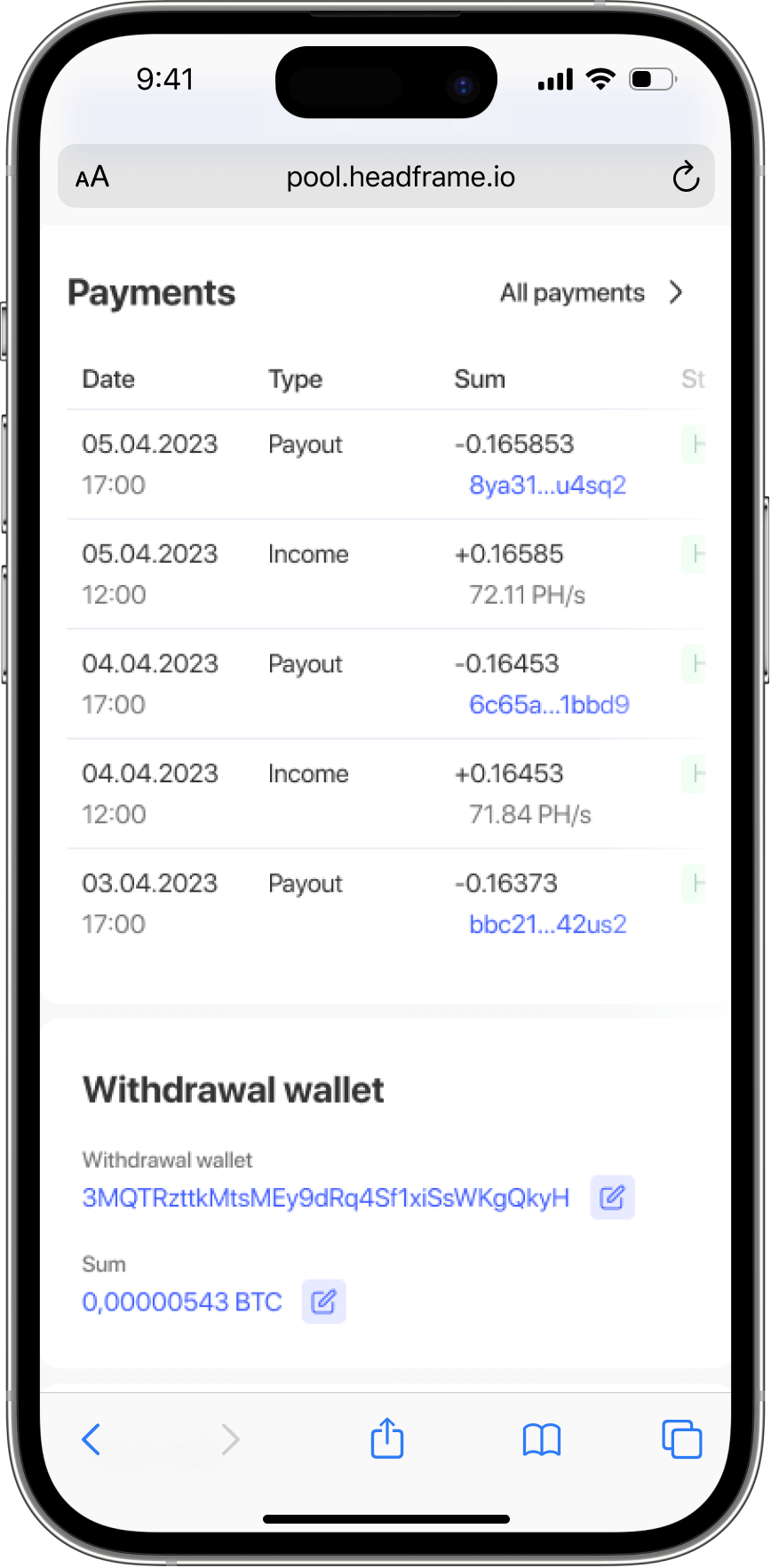
After 72 hours Net BTC earned, payout timing, support response if you asked a question, and difference from calculator forecast. Gives enough data to compare pools under similar conditions.

When you compare pools, keep the ASIC model, firmware, hashrate, power settings and electricity tariff the same. If you change several variables at once, you will not know whether the difference came from the pool, the miner or the environment. For a wider profitability view, use the guide on how much you can make from mining and check the power-cost side with the mining farm power consumption guide.

When the largest pool is not the best pool

Hashrate share is useful because it shows scale and block-finding frequency. It does not automatically show net profitability for your ASICs. A miner with one S21 at home, a hosted rack of WhatsMiners and an institutional site with power-market exposure may all choose different pools for rational reasons.

Large pools can offer strong infrastructure and predictable block discovery, but they may also have higher fees, stricter onboarding, less flexible support or weaker routing from your location. Smaller or specialized pools can be better when they deliver lower real cost, cleaner monitoring and fewer stale shares for your specific setup.

FAQ

What is the best mining pool for Bitcoin?

For most ASIC miners, the best mining pool is the one with a clear payout model, low real fee, stable stratum connection, transparent statistics and payout rules that fit your hashrate. Headframe is a strong first test for miners who want FPPS, a 0.9% standard fee and daily BTC payouts.

Is the largest Bitcoin mining pool always the most profitable?

No. The largest pool may find blocks more frequently, but your net result also depends on fee, stale shares, payout model, routing, downtime and withdrawal rules.

What is a BTC mining pool fee?

It is the share of mining rewards kept by the pool for infrastructure and payout risk. Always check the fee for the exact payout model you plan to use, because FPPS, PPS+, PPLNS and SOLO can have different economics.

Is FPPS better than PPLNS?

FPPS is usually better for miners who want predictable income and easier accounting. PPLNS can be reasonable for miners who stay on one pool for a long time and accept more variance.

How long should I test a Bitcoin mining pool?

Run at least 24 hours to catch obvious connection and dashboard issues. A 72-hour test is more useful for comparing accepted hashrate, stale shares and payout behavior.

Can I switch mining pools?

Yes. ASICs can usually switch pools by changing the stratum URL, worker name and password. Before switching a full farm, test one miner or one group of miners first.

Do beginners need a mining pool?

Yes, if they mine Bitcoin with ASICs. Solo mining is too unpredictable for most users, while a pool gives regular payouts and visible worker statistics.

Does pool choice change mining profitability?

Yes. The difference may come from fee, payout model, stale shares, downtime, payout threshold or support quality. Compare pools with the same ASIC settings and the same electricity assumptions.

Does pool hashrate affect profitability?

Pool hashrate affects block-finding regularity and payout variance, but it does not decide profitability by itself. Net results still depend on fee, payout model, stale shares, downtime, minimum payout and how accurately the pool credits your accepted hashrate.

What is Vardiff in pool mining?

Vardiff means variable share difficulty. The pool adjusts share difficulty so slow and fast ASICs can submit shares at a useful rate without overloading the connection or making worker statistics noisy.

What should I compare after switching pools?

Compare accepted hashrate, stale and rejected shares, BTC credited, payout timing, support response and the gap between the calculator forecast and the real pool dashboard. Keep ASIC settings and electricity assumptions unchanged during the test.

Final checklist before choosing a pool

  • Confirm the coin, algorithm and payout model.
  • Check the exact pool fee and payout threshold.
  • Use the closest stable stratum endpoint.
  • Run a 24-72 hour test with one ASIC or a small group.
  • Compare accepted hashrate, stale shares and actual BTC credited.
  • Keep the same ASIC settings when comparing two pools.
  • Choose the pool that gives the cleanest net result, not the one with the loudest marketing.

For many Bitcoin ASIC owners, a sensible path is to start with Headframe, record the baseline, and then compare one alternative pool only if the numbers justify the switch. The pool decision should make mining easier to operate and easier to audit, not harder to explain.

Article rating
4.7 / 5

17 rated this article

Rate this article

Join headframe

Join headframe Join headframe
0.9% FPPS