ASIC Miner Guide for Bitcoin Mining Hardware
In 2026, an ASIC miner remains the core piece of hardware behind professional cryptocurrency mining. If you are researching how Bitcoin mining works, how to choose an ASIC miner, or whether ASIC mining is still profitable, the short answer is simple: ASIC devices are purpose-built machines designed to deliver maximum hash power with the best possible energy efficiency.
For miners in Russia and other competitive markets, understanding what an ASIC is, how it works, and how to evaluate profitability is the first step toward building a sustainable mining operation.
What Is an ASIC in Simple Terms?
If you have ever looked into cryptocurrency mining, you have probably come across the term ASIC. It stands for Application-Specific Integrated Circuit. Unlike a regular PC or laptop, which can handle many different tasks, an ASIC miner is built for one job only: calculating a specific hashing algorithm as fast and as efficiently as possible.
A simple comparison is a professional race car. You would not use it for grocery shopping or moving furniture, but on a racetrack it will outperform an ordinary car by a huge margin. An ASIC miner works the same way. It is not made for gaming, office work, or streaming video. Its chips are optimized for mining algorithms such as SHA-256, which is used by Bitcoin. That narrow specialization is exactly what makes ASIC mining so powerful in 2026.
The Evolution of Mining: From CPU to ASIC
The history of mining hardware is a story of constant efficiency gains. Looking back at early Bitcoin mining today is like studying the blueprint of the first steam engine.
- CPU era: In 2009 and 2010, Bitcoin could be mined on an ordinary home computer. Early enthusiasts used standard processors to secure the network and earn coins.
- GPU era: It quickly became clear that graphics cards handled parallel calculations much better than CPUs. GPU mining dominated for several years as miners chased higher hashrate.
- FPGA era: Field-programmable gate arrays became a transitional step. They were faster and more efficient than GPUs, but they were harder to configure and scale.
- ASIC era: The real revolution began when specialized ASIC hardware entered the market. From that point on, Bitcoin mining turned into a professional industry built around performance, uptime, and power efficiency.
Today, if you want to mine Bitcoin competitively, an ASIC miner is no longer optional. It is the industry standard.
How Does an ASIC Miner Work?
An ASIC miner works by performing an enormous number of hash calculations in order to find a valid block hash. This process is part of the Proof-of-Work model used by Bitcoin and several other cryptocurrencies.
Inside a typical ASIC miner, you will usually find the following components:
- Hash boards: These are the core of the machine. Each board contains many specialized chips that perform billions or trillions of calculations every second.
- Control board: This is the device’s command center. It manages the mining process, communicates with the mining pool, and tracks key system parameters.
- Cooling system: High-speed fans move large volumes of air through the miner to remove heat from the chips and heatsinks.
- Power supply unit: ASIC miners require stable high-load power delivery, often in the multi-kilowatt range depending on the model.
For stable operation, an ASIC miner needs constant power, reliable internet access, and an active connection to a mining pool. Without that infrastructure, even powerful hardware cannot generate predictable results.
Types of ASIC Miners and What They Mine
ASIC miners are not universal devices. Each model is designed for a specific algorithm, which means you cannot simply buy a Bitcoin ASIC and switch it to any random coin. The main categories used in the market today include:
| Algorithm | Common Coins | Main Characteristics |
|---|---|---|
| SHA-256 | Bitcoin (BTC), Bitcoin Cash (BCH) | The most established category, focused on maximum performance and strong network security. |
| Scrypt | Litecoin (LTC), Dogecoin (DOGE) | Popular for merged mining setups and known for broad market demand. |
| X11 | Dash | A more specialized segment with different profitability dynamics and lower market scale than Bitcoin mining. |
| Other niche ASIC categories | Network-specific coins | Can offer attractive returns in certain cycles, but income tends to be more volatile and less predictable. |
In 2026, most professional miners in Russia still prioritize Bitcoin ASIC mining. BTC remains the most liquid large-scale mined asset, and it is generally the easiest to integrate into a long-term treasury or convert into fiat when needed.
Advantages and Disadvantages of ASIC Mining
Mining with professional hardware is always a tradeoff between high revenue potential and real technical constraints.
Advantages
- Maximum profitability: For Bitcoin mining, no GPU setup can compete with a modern ASIC miner in terms of raw hashrate and efficiency.
- Easy deployment: Compared with GPU rigs, ASIC miners are much simpler to set up. In most cases, the process is close to plug-and-play.
- Compact form factor: One modern ASIC can replace a large multi-GPU setup while using far less space.
Disadvantages
- High noise levels: An operating ASIC miner sounds more like industrial equipment than home electronics. Running one in a residential apartment is rarely practical without additional sound insulation.
- Heavy heat output: ASIC miners generate a lot of heat. In winter that can be useful, but in warm seasons it requires proper intake and exhaust ventilation.
- Narrow specialization: An ASIC is tied to its algorithm. That makes hardware selection more important, because flexibility is limited compared with general-purpose computers.
How to Choose an ASIC Miner in 2026
Choosing the right hardware in 2026 requires more than comparing sticker prices. A cheap machine can easily turn into an expensive mistake if it burns too much electricity or creates constant maintenance issues.
- Hashrate: This is the machine’s computational output, usually measured in terahashes per second (TH/s). Higher hashrate generally means more mining potential.
- Energy efficiency: The most important metric for most miners today is J/TH, or joules per terahash. The lower this number is, the less electricity the miner consumes for each unit of work.
- Brand reliability: Established manufacturers such as Bitmain, MicroBT, and Canaan remain the best-known names in the ASIC market.
- Total entry cost: The miner’s price is only part of the budget. You also need to factor in delivery, customs, electrical upgrades, ventilation, and installation.
Expert tip: In the Russian market, used ASIC units from older generations are still widely available. For beginners, newer and more efficient models are usually the safer choice, especially if electricity costs are not extremely low.
ASIC Mining Economics
ASIC mining profitability should always be calculated like a real business, not like a guess. A simplified formula looks like this:
Profit = (Coins Mined × Market Price) – (Electricity + Maintenance + Pool Fee)
The price of electricity plays a decisive role. If your power costs are too high, even strong hardware may deliver weak returns. That is why industrial miners focus so heavily on location, tariff structure, and energy efficiency.
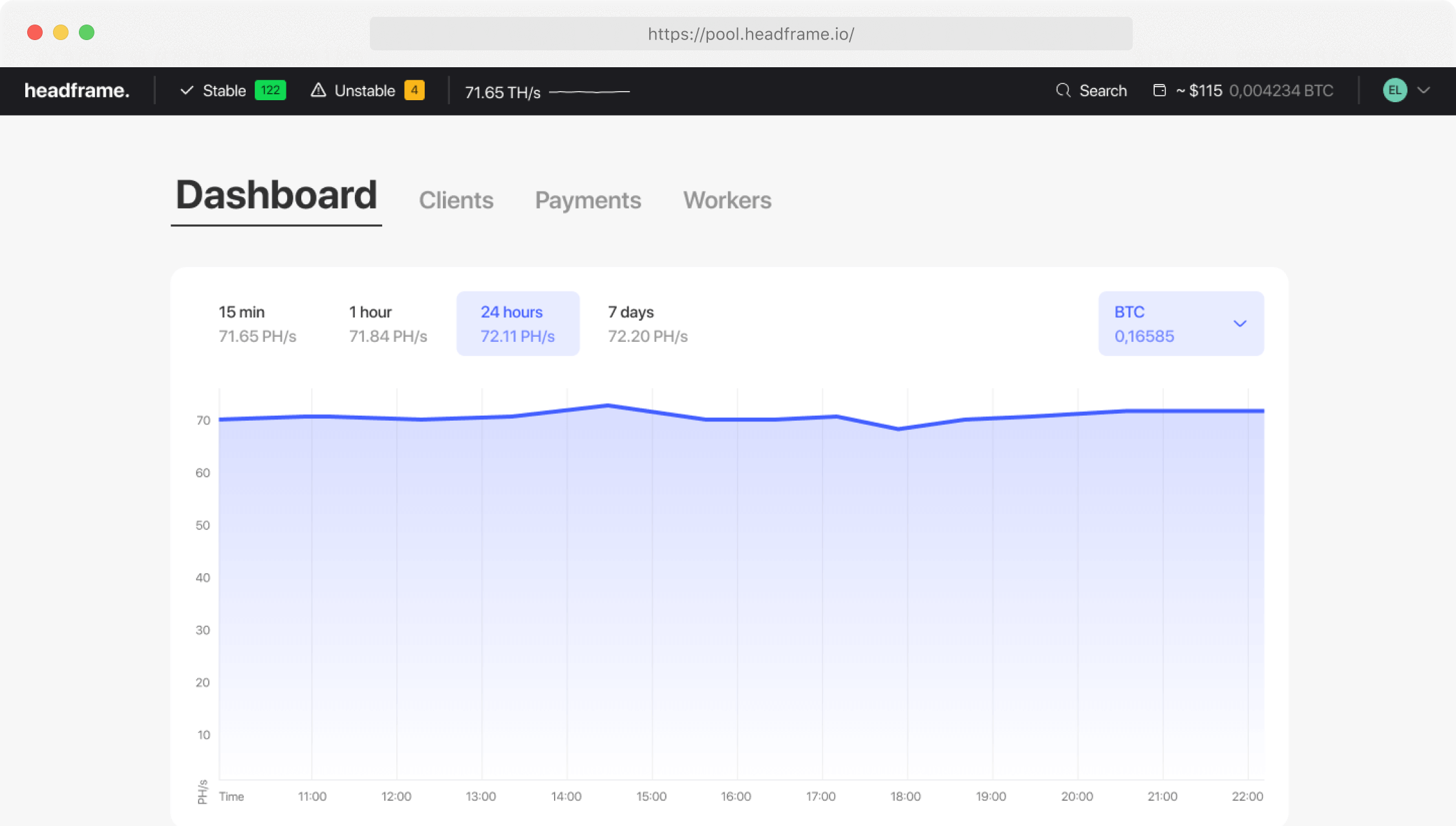
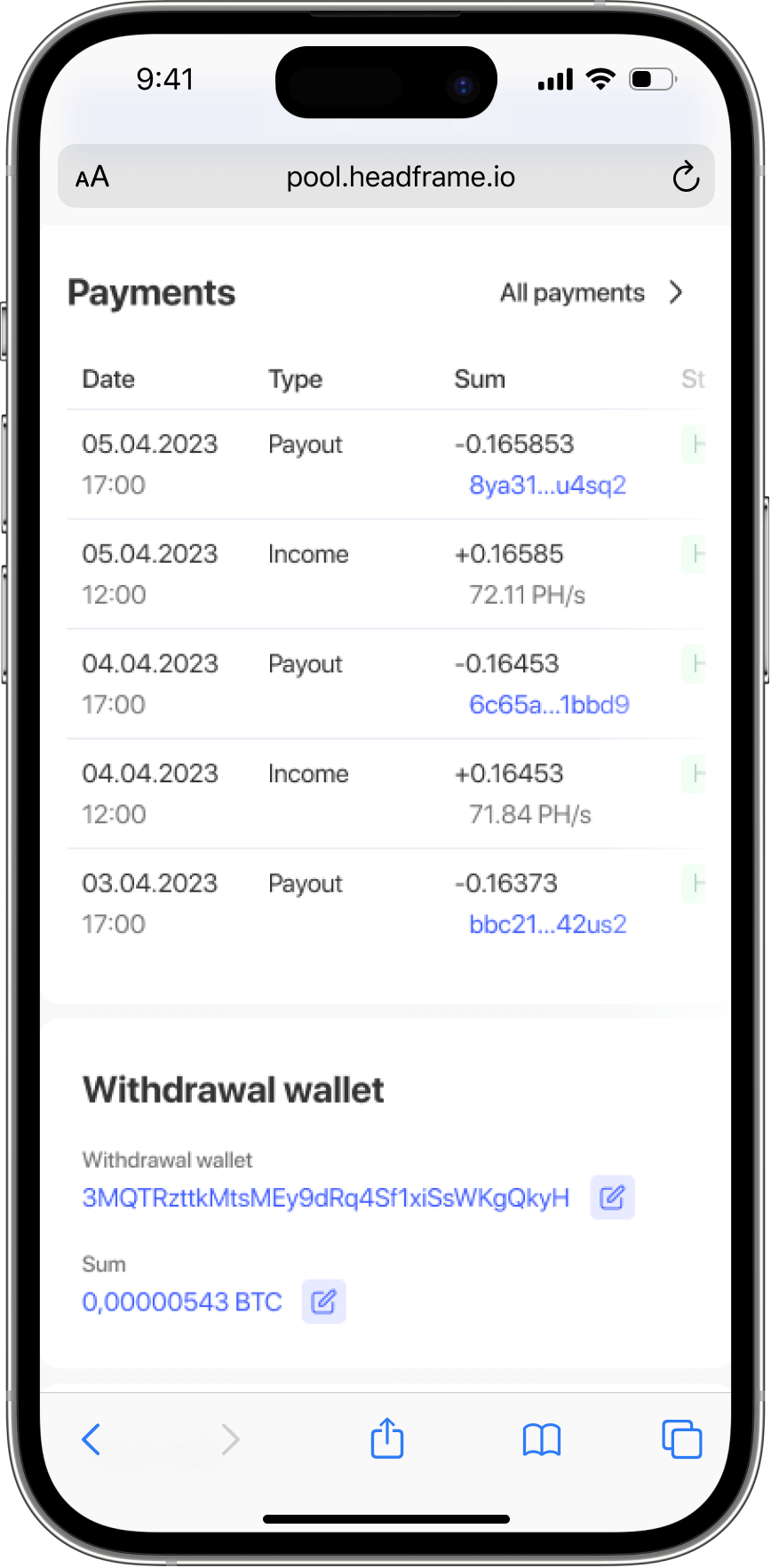
The mining pool you choose also matters. Some pools advertise low fees but use payout systems that are less transparent or less stable. Headframe offers an FPPS model with a 0.9% fee and daily payouts, which helps miners receive rewards that include both the block subsidy and transaction fee component of network revenue.
How to Start Mining With an ASIC
If you want to enter the mining business in 2026, the process usually looks like this:
- Prepare the location: Check the wiring, available load, ventilation, and internet stability before you buy equipment.
- Buy the hardware: Work with trusted suppliers who provide documentation, warranty terms, and support.
- Choose a mining pool: Stable payouts, clear reporting, and low fees matter more than marketing slogans.
- Configure the ASIC: Enter the pool address and worker credentials in the web interface.
- Set up your wallet: Add your BTC wallet address to receive mining rewards.
At that point, your focus shifts from setup to operations: uptime, temperature control, power management, and monitoring.
The Future of ASIC Mining
ASIC mining is becoming more institutional every year. Large operators continue building industrial mining sites and data-center-scale facilities. At the same time, private miners in Russia still have opportunities to run profitable operations if they can secure efficient hardware and access to relatively affordable electricity.
The technology is also moving forward. Air cooling still dominates, but immersion cooling is gaining traction in professional environments because it can reduce noise, improve thermal stability, and support more aggressive performance tuning.
Bitcoin remains the most liquid mined digital asset, and ASIC mining is still the most efficient way to acquire it directly from the network. For miners who approach the process strategically, with realistic economics and the right pool infrastructure, ASICs continue to be one of the strongest tools in the mining industry in 2026.
How to Compare an ASIC Miner Before Buying
A bitcoin miner or btc miner should be judged by efficiency, not only advertised hashrate. Two bitcoin miners with the same TH/s can produce very different net profit when their power draw, firmware, pool rejects and cooling needs differ.
For crypto mining, ASIC hardware is usually algorithm-specific. A Bitcoin ASIC runs SHA-256; a Litecoin or Dogecoin ASIC runs Scrypt. Matching the miner to the coin and pool is the first profitability check.
Before purchasing an ASIC miner bitcoin operators should model revenue with current difficulty, pool fee and electricity price, then leave room for downtime and maintenance.
ASIC Miner Buying Checklist
| Signal | What to check |
|---|---|
| Hashrate | The advertised TH/s or GH/s output under normal operating conditions. |
| Efficiency | J/TH or W/TH determines how much power the miner needs per unit of hashrate. |
| Algorithm | Bitcoin ASIC miners use SHA-256; Scrypt miners are for Litecoin and Dogecoin. |
| Pool fit | Check Stratum stability, payout model, stale share rate and regional latency. |
| Total cost | Include PSU, cables, cooling, hosting, repairs and downtime, not only device price. |
Internal Links for the Next Step
- Bitcoin mining calculator for profitability scenarios.
- Best mining pool guide for payout, fee and uptime checks.
- ASIC miner guide for hardware and efficiency basics.
FAQ
What is a bitcoin miner?
A bitcoin miner is usually a SHA-256 ASIC device that searches for valid Bitcoin block hashes.
Are bitcoin miners different from crypto mining rigs?
Yes. Bitcoin miners are specialized ASICs, while many crypto mining rigs are GPU-based and built for other algorithms.
What does btc miner mean?
BTC miner is a short phrase for Bitcoin mining hardware or a person operating Bitcoin mining equipment.
Can one ASIC miner mine every coin?
No. ASIC miners are algorithm-specific, so a SHA-256 ASIC cannot efficiently mine Scrypt coins.
How do I estimate ASIC profitability?
Use current hashrate, power draw, electricity price, pool fee, network difficulty and coin price in a mining calculator.